Introduction
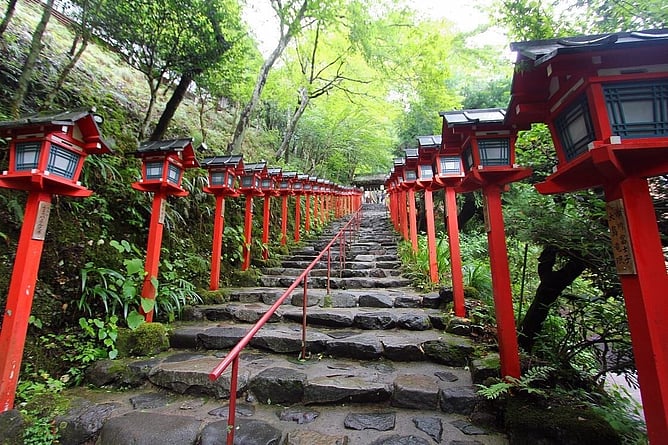
In the spring of 1922, a Japanese spiritual seeker named Mikao Usui descended from a twenty-one-day fasting retreat on Mount Kurama carrying something he had not carried up: a direct, embodied experience of universal life energy - and the knowledge of how to share it. Over the century that followed, what he brought down from that mountain would reach every inhabited corner of the world, including the healing rooms, hospitals, and community centres of Aotearoa New Zealand.
This article traces that journey, from Reiki's roots as a path to enlightenment, through its key teachers and many Western forms, to its arrival here, and the training standards upheld today by Reiki NZ Inc.
Reiki as a Path to Enlightenment
At its heart, Reiki is a spiritual path
It is a common misunderstanding in the West to think of Reiki primarily as a healing technique - a method for reducing stress, easing pain, or restoring energy. These outcomes are real and well-documented, but, within the framework Usui himself established, they are expressions of something far deeper.
At its heart, Reiki is a spiritual path - a structured way of awakening to the nature of consciousness, life energy, and one's own essential being. Healing, in this view, is not the destination. It is what naturally occurs when a person aligns ever more fully with the source of life itself.
The Five Precepts or Gokai: The Foundation of the Path
Usui placed the five Reiki Precepts or Gokai, at the very centre of his teaching — not as ethical guidelines tacked on to a healing system, but as its living foundation. Recited each morning and evening with hands in Gassho at the heart, they were to be lived and returned to continually:
Just for today, do not be angry.
Just for today, do not worry.
Just for today, be grateful.
Just for today, do your work fully.
Just for today, be kind to all living beings.
The phrase kyo dake wa - "just for today" - is significant. Usui was not asking for permanent perfection but for moment-to-moment practice: the returning, again and again, to presence and intention.
Usui taught the precepts as a daily practice, recited morning and evening with hands in the Gassho position (palms together at the heart). They were to be reflected upon, lived, and returned to when one fell short, not as a source of guilt but as a compass pointing back to one's deeper nature.
Reiki as a 'do' - a Way of Being
In the Japanese cultural context, a 'do' is a 'way' - a discipline that cultivates not just skill but character and, ultimately, awakening. Judo, kendo, the tea ceremony, all are do in this sense. Usui understood Reiki this way. The word rei carries connotations of the sacred and the numinous; ki is the vital life energy that animates all things. To practise Reiki, in Usui's understanding, is to consciously align oneself with that sacred energy, and in doing so, to gradually open to one's own deeper nature.
The original practice also included significant meditative elements — among them Hatsurei-ho, a complete practice combining purification, energy cultivation, and contemplative attention — that were largely simplified as Reiki moved West.
Meditation, Intuition, and the Inner Journey
The original Reiki practice included significant meditative and contemplative elements that were simplified or set aside as the system moved West. Usui taught a range of techniques for developing inner awareness and energetic sensitivity.
He also taught Hatsurei-ho, a complete meditative practice combining purification, energy cultivation, and contemplative attention. Students were expected to practise this daily - it was considered at least as important as the hands-on healing work, for the simple reason that the quality of the healing flows from the quality of the practitioner's own inner life.
Usui's most advanced students were taught Reiji-ho — literally, "indication of the spirit method." Rather than following a fixed set of hand positions, the practitioner trained their intuition to guide their hands to exactly where energy was needed. This was not a technique that could be learned in a weekend. It was the fruit of sustained practice, deepening sensitivity, and genuine spiritual development over time, the natural outcome of a practitioner who had become, through long years of inner work, a truly clear and sensitive channel for healing energy.
Satori: The Moment on Mount Kurama
The experience Usui had on Mount Kurama in 1922 is described in Japanese as satori - a sudden, direct awakening to the nature of reality. He had been fasting for twenty-one days on the mountain, engaging in intensive meditation and spiritual practice.
In the final moments of his retreat, he reported an overwhelming influx of light and energy that filled him with extraordinary vitality. In the days that followed, he discovered that this energy could be transmitted to others through touch and that it brought measurable relief and healing.
This experience sits within a well-established tradition of transformative spiritual encounters in Japanese and broader Asian spiritual culture. What distinguished Usui's insight was his recognition that the energy he had encountered could be shared, and his commitment to developing a systematic, accessible path that could bring others into contact with it.
He was not simply reporting a personal mystical experience; he was designing a teachable path by which others might progressively open to the same reality, at their own pace, according to their own nature.
This is why, for those who practise Reiki with genuine depth and commitment, it tends to become more than a healing modality over time. Students often report that regular self-practice, daily use of the precepts, and sustained meditation bring about gradual but profound shifts in perception, in emotional life, in their relationship to difficulty and uncertainty, and in their sense of who and what they are.
These changes are not always dramatic. More often, they are quiet, cumulative, and deeply sustaining. They are the signs of a path doing what paths do.
Part 2: The three Founders of the Western Lineage - Usui, Hayashi and Takata
Mikao Usui (1865–1926)
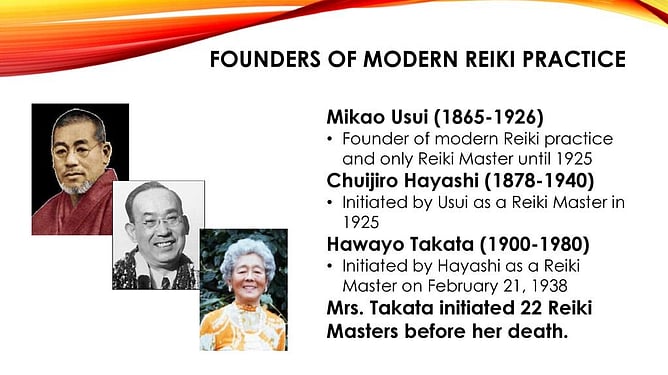
Mikao Usui was born in Japan's Gifu Prefecture in 1865, during a period of sweeping national transformation. A man of broad intellectual curiosity, he studied medicine, theology, Buddhist and Shinto teachings, Chinese classics, divination, and martial arts throughout his life. Following the transformative retreat on Mount Kurama described above, he established the Usui Reiki Ryoho Gakkai in Tokyo in 1922 and devoted the remaining years of his life to teaching.
He is said to have worked with over 2,000 students, of whom between sixteen and twenty reached the highest level of training he recognised - the Shinpiden, or "mystery teachings." He passed away in 1926.
Chujiro Hayashi (1880–1940)
A retired naval physician and one of Usui's senior students, Chujiro Hayashi established his own practice - the Hayashi Reiki Kenkyu-kai - in Tokyo after Usui's death. Hayashi brought a clinical sensibility to the work. He developed systematic hand placement protocols, created structured approaches to treating specific conditions, and ran a clinic where patients could receive extended courses of treatment.
Between thirteen and sixteen Masters were initiated in his lineage. It was at his clinic that Hawayo Takata, arriving from Hawaii in 1936, first encountered Reiki and received the treatment that she credited with restoring her health.
Hawayo Takata (1900–1980)
Born in Hawaii to Japanese immigrant parents, Hawayo Takata was widowed young and arrived in Japan in the mid-1930s in poor health. After receiving Reiki treatments at Hayashi's clinic and experiencing what she described as a remarkable recovery, she remained to study under Hayashi from 1936 to 1938, becoming one of his last Masters. She returned to Hawaii, began practising, and over the following decades became the first person (as we currently know) to teach Reiki in the Western world.
Takata was a gifted and practical teacher who understood that Reiki needed to be communicated in terms that resonated with Western students. She streamlined hand positions, simplified training levels, and framed the practice in language accessible to people without a background in Japanese spirituality. Between approximately 1970 and her death in December 1980, she initiated twenty-two Reiki Masters - people who became the roots from which virtually all Western Reiki has since grown.
Part 3: Reiki Moves West - Preservation, Adaptation, Innovation
When Takata's twenty-two Masters began teaching after her death, they did so without a central authority or shared curriculum. Reiki had been passed on through an oral tradition - person to person, teacher to student - and each Master carried both the essence of the practice and their own particular understanding of it. What followed was a remarkable flowering of diversity, producing three broad approaches:
• Preservation
Maintaining Takata's teachings as faithfully as possible, as exemplified by Phyllis Lei Furumoto (Takata's granddaughter and Lineage Bearer) and The Reiki Alliance.
• Adaptation
Incorporating elements of Western psychology, chakra systems, or particular spiritual traditions to make Reiki more accessible to Western students.
• Integration
Combining Reiki with other healing modalities, producing new systems such as Karuna Reiki®, Angelic Reiki, and Holy Fire Reiki.
Why so Many Branches Emerged
Takata Sensai passed Reiki on as an Oral Tradition
Knowledge passed directly from teacher to student naturally created variation; each Master's understanding shaped what they passed on.
No governing body was formed prior to Takata Sensai's passing
After Takata's death, no single organisation held authority over how Reiki was taught worldwide.
Cultural translation and adaptations
Moving a Japanese spiritual practice into Western contexts required translating not just language but concepts, frameworks, and assumptions.
Personal revelations added and called 'Reiki'
Many Western teachers reported receiving new insights or techniques through meditation, which they incorporated into their teaching, consistent with the broader Western spiritual culture of the late twentieth century.
Part 4: Making Sense of the Names
One of the first things a new Reiki student notices is the variety of names attached to different traditions. Understanding what these names mean - and what they don't - is genuinely helpful for anyone beginning to navigate contemporary Reiki practice.
Usui Reiki Ryoho - The Original Japanese Name
The original name Usui gave his system, still used by the Usui Reiki Ryoho Gakkai in Japan, emphasising spiritual cultivation and intuitive practice.
Usui Shiki Ryoho - The Western Form
'Usui Style Healing Method,' the name adopted by Takata's successors for the Western tradition, is structured around three levels .
Reiki I or Reiki First Degree
Attunement, foundational hand positions, self-healing and healing of others.
Reiki II or Reiki Second Degree
Sacred symbols, distance healing, and mental-emotional healing applications.
Reiki III or Master-Teacher
Advanced practice and, for those who choose it, the ability to attune and teach students.
This is the form I was trained (and have taught for 30 years in NZ) in Sydney, Australia.
Usui Shiki Reiki Ryoho - A Blended Label
A blended label combining both names. Not a distinct tradition; simply a descriptive term for teaching in the Takata–Furumoto lineage.
Part 5: Japanese Reiki Comes to the World
From the 1990s onward, Japanese teachers began bringing the original forms of Reiki to an international audience - preserving elements of Usui's spiritual emphasis that had been simplified as the practice moved West.
Jikiden Reiki, established in 2000
'Directly Transmitted.' Founded by Chiyoko and Tadao Yamaguchi, preserving Reiki as Hayashi taught it. Chiyoko had been initiated by Hayashi himself in 1938.
Jikiden Reiki includes techniques such as Byosen Reikan-ho (systematic body scanning to detect energetic disturbance) and preserves Hayashi's understanding of byosen - the sensations in the practitioner's hands that indicate where healing energy is most needed.
Komyo ReikiDo - established in 1998
Founded by Buddhist monk Hyakuten Inamoto following study with Chiyoko Yamaguchi. Presents Reiki explicitly as a do or a spiritual path rather than a therapeutic technique.
The emphasis is on daily self-practice, the precepts as a foundation for living, and the gradual deepening of the practitioner's relationship with universal life energy as the true purpose of the practice.
Gendai Reiki Ho - established in 1995
Founded by Hiroshi Doi, a former member of the Usui Reiki Ryoho Gakkai. Bridges the Japanese tradition and Western forms, taught through four levels internationally.
Part 6: Hawayo Takata's 22 Reiki Masters
The twenty-two individuals Takata initiated between approximately 1970 and 1980 represent one of the most consequential groups in the history of complementary health. Each carried the practice into their own community, country, and context - the roots of a global healing community now numbering in the millions.
Hawayo Takata's 22 Reiki Masters
Barbara Ray | 1979
Founded The Radiance Technique® in the early 1980s. First to formally register Reiki in the U.S. Taught Reiki as both a scientific and deeply spiritual discipline.
Iris Ishikuro | 1973
Known for her open approach to teaching. Her lineage influenced the development of Seichim and Karuna Reiki®. Her student Arthur Robertson developed Reiki Plus.
Phyllis Lei Furumoto | 1979
Takata's granddaughter and recognised successor. Became Lineage Bearer of Usui Shiki Ryoho and co-founded The Reiki Alliance with Paul David Mitchell.
Beth Gray | 1970s
One of Takata's earliest Masters. In 1983 she travelled to Australia and New Zealand, pioneering Reiki in the Oceania region.
Fran Brown | 1970s
Author of Living Reiki (1992), one of the earliest published accounts of Takata's teachings.
John Gray | 1970s
Instrumental in bringing Reiki to Canada, where he taught widely.
Wanja Twan | 1970s
Swedish-born Canadian Master. Taught across Canada, the U.S., and Europe. Author of In the Light of a Distant Star.
Kay Yamashita | 1970s
Continued Usui Shiki Ryoho. Takata's sister-in-law.
Barbara McCullough | 1970s
aught within Takata's system.
Paul Mitchell | 1970s
Worked closely with Phyllis Furumoto. Served as Head of Discipline within The Reiki Alliance.
Rick Bockner | 1980
The last Master initiated by Takata (November 1980). Still active in Canada.
Mary McFadyen | 1970s
Helped spread Reiki across Canada.
Shirley Price | 1970s
Brought Reiki to the United Kingdom.
Ethel Lombardi | 1970s
U.S.-based teacher. Occasionally associated with early Seichim, though her primary focus remained Reiki.
Beth Sanders | 1970s
Continued her practice in Hawaii.
Paul David Mitchell | 1970s
Long-standing partner of Phyllis Furumoto in stewarding Usui Shiki Ryoho internationally.
Anneli Twan | 1970s
Related to Wanja Twan. Practised and taught within the Usui Shiki Ryoho tradition.
Kay Wheeler | 1970s
Continued teaching and practising Usui Shiki Ryoho.
Virginia Samdahl | 1976
First Reiki Master initiated on the U.S. mainland.
Harry Kuboi | 1970s
Among the early Hawaiian Masters.
Shizuko Yamaguchi | 1970s
Taught within the local Hawaiian community.
Takata's remaining initiates | 1970s
A small number of Takata's students are less thoroughly documented in available historical records.
Part 7: Reiki arrives in Aotearoa - the Southern Hemisphere Story
Reverend Beth Gray and the 1983 Mission South
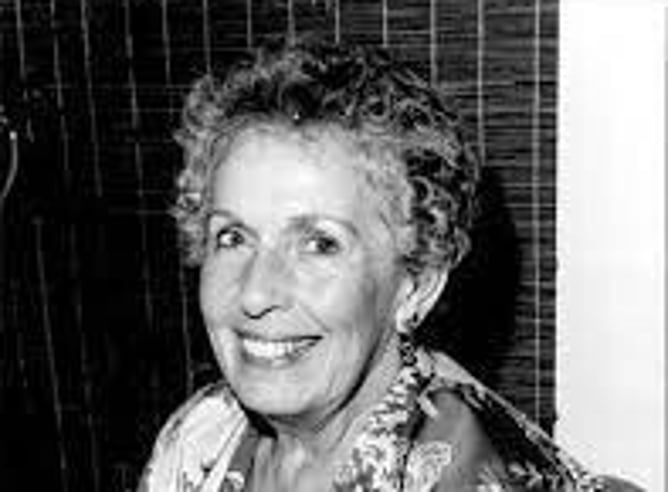
Of Takata's twenty-two Masters, it was Reverend Beth Gray (1918-2008) who pioneered Reiki in the Southern Hemisphere. A Hawaiian-based minister and one of Takata's earliest students, Gray arrived in Australia in September 1983 (at the age of sixty-five) and began teaching with characteristic commitment and energy. What she set in motion in those first workshops shaped both countries' Reiki communities to this day.
Beverly Bultitude is confirmed as a direct student of Beth and John Gray, and one of the original Reiki teachers in Australia. She was my 1st Degree and 2nd Degree Reiki teacher in Sydney in 1994.
Gray returned to Australia on multiple occasions, teaching across cities and regions, initiating the first generation of local Reiki Masters, and establishing lineages that remain active and visible in both countries' communities.
Her work ensured that Reiki in the Southern Hemisphere was grounded from the beginning in hands-on practice, personal responsibility, and the oral tradition as Takata had emphasised it.
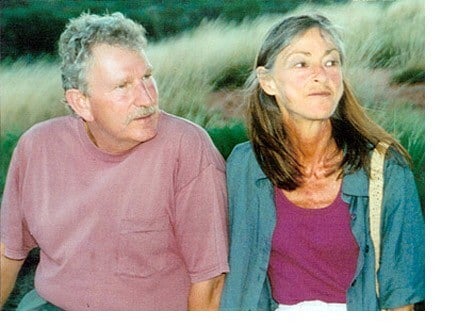
Denise Crundall (1946–2002): Ministry Through Reiki
Among Beth Gray's early Australian students, Denise Crundall found her particular calling in taking Reiki to those most in need. Over five years of apprenticeship with Gray, she identified her ministry in working with people living with HIV/AIDS and those facing the end of life - this during the early years of the AIDS crisis, a time of profound suffering and significant social stigma.
On 4 July 1988, in Sydney, Beth Gray formally announced to the Reiki community that Denise was a Master of the Usui System of Natural Healing. Denise subsequently extended her work to California, offering teaching and healing to people with terminal illness, and broadened her practice over time to encompass children, teenagers, and the wider community.
In 1991 she invited her husband John to join her, and together they trained teachers and established healing communities wherever they worked. After Denise's death in 2002, John continued the work they had built together.
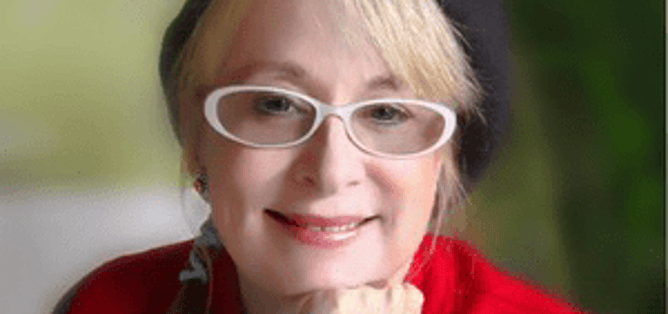
Barbara McGregor: Building a Professional Community
Another of Beth Gray's significant students, Barbara McGregor, based in Melbourne, devoted considerable energy to building professional infrastructure for Reiki in Australia. Her establishment of the Usui Reiki Network in 1990 provided practitioners with a community framework and shared commitment to standards.
Barbara McGregor went on to found the Usui Rei-ki Network International in 1990, which established centres across Australia and also in Auckland, New Zealand. She is therefore the most significant figure in bringing Beth Gray's lineage into New Zealand through that network.
McGregor's work helped shift the perception of Reiki from an informal spiritual practice to a serious complementary health discipline - a shift whose significance would only grow as professional recognition of Reiki developed across the region.
Part 8: Why in-person Training Matters
From its very beginning, Reiki has been transmitted in person.
The attunement, known in the Japanese tradition as Reiju, or "giving of spirit", is understood not as a set of instructions that can be read from a screen but as a direct energetic transmission from an experienced teacher to a student. Something passes between them that words and video cannot carry.
This is not a romantic notion; it is consistent with the way energy healing of all kinds has been transmitted across every culture and throughout history.
The rise of online learning has created genuine opportunities to extend Reiki education: video resources, guided meditations, online communities, and written materials all support a student's ongoing development. Many experienced teachers now offer hybrid programmes that combine in-person intensive workshops with online resources between sessions - a sensible and appropriate use of technology.
What online platforms cannot provide is the attunement itself, the direct demonstration of technique, the immediate guidance of a teacher's presence as a student practises, or the subtle relational field that develops when people learn Reiki together in a room.
These are not optional extras. They are, in many respects, the heart of Reiki.
Reiki NZ Inc - Training Standards for Aotearoa New Zealand
Reiki NZ Inc. is the professional body for Reiki teachers and practitioners in Aotearoa New Zealand, affiliated with the Natural Health Practitioners of New Zealand (NHPNZ). The minimum training standards it upholds have been accepted by NHPNZ, giving Reiki formal validation as a natural health practice in this country.
From its very beginning, Reiki has been transmitted in person. The attunement or Reiju, or 'giving of spirit', is understood as a direct energetic transmission from teacher to student. Something passes between them that words and video cannot carry.
Online platforms can support a student's ongoing development. What they cannot provide is the attunement itself, the immediate guidance of a teacher's presence, or the subtle relational field that forms when people learn Reiki together in a room.
Reiki NZI Training Standards for Aotearoa, New Zealand
Reiki NZ Inc. is the professional body for Reiki teachers and practitioners in Aotearoa, affiliated with the Natural Health Practitioners of New Zealand (NHPNZ). Its minimum standards include:
• Traceable lineage back to Mikao Usui, provided to students on completion of each level.
• Minimum in-person hours at each level (Level 1: minimum 12 hours; each level requiring integration time before proceeding)
Level 1 or Reiki First Degree
Level 2 or Reiki Second Degree
Level 3 or Reiki Master 3A
Reiki Teacher 3B
• No combined-level packages: Levels 1, 2, and 3 are not taught together in accelerated programmes.
• Code of Ethics: All members sign a Code of Ethics and Rules of Practice on joining.
To find a Reiki NZ Inc. member teacher or practitioner in your area, or to see the minimum teaching hours and content of each Degree, visit reiki.org.nz.
Online Reiki Training
Reiki NZ Inc. endorses approved online training by its Members only. For full professional Membership, in-person training and demonstrated experience are required.
Code of Ethics
All members sign a Code of Ethics and Rules of Practice as part of their Membership contract. Practitioners are expected to abide by all relevant laws of Aotearoa New Zealand and to maintain confidentiality, professional boundaries, and a safe practice environment.
To find a Reiki NZ Inc. member teacher or practitioner in your area, visit reiki.org.nz.
“Reiki NZ Inc.’s commitment to in-person training and traceable lineage is not a refusal to embrace technology. It is a commitment to protecting what is most essential and irreplaceable about genuine Reiki transmission - for both practitioners and the people who come to them for care.”
Yolanda Cholmondeley-Smith, Reiki Health NZ, 2026
Conclusion: Many Streams, One Ocean
A hundred years have passed since Mikao Usui came down from Mount Kurama carrying what would become one of the world's most widely practised forms of energy healing.
In the century since, Reiki has moved from a small Tokyo healing society to communities on every inhabited continent - including here in Aotearoa New Zealand, where Beth Gray planted its first seeds in 1983 and where a growing community of dedicated practitioners continues to carry it forward.
This journey has produced genuine diversity in styles, names, emphases, and cultural expressions. It has also produced occasional confusion and, here and there, practices that have drifted far from the original spirit of Usui's work.
Navigating this landscape is easier when we remember what Usui himself placed at the centre: not a technique, not a set of symbols, not a particular hand position - but a way of living, moment by moment, in greater alignment with the source of life itself. The precepts. The daily practice. The ongoing, humble commitment to one's own inner development.
Whatever form of Reiki you practise or experience - whether you follow a Japanese lineage close to Usui's original teaching, a Western style that came through Takata's transmission, or one of the many integrative approaches that have developed since - the invitation is the same: to let the practice change you.
Not just your hands, but your heart. Not just what you do in a session, but how you move through the world.
Learning Reiki in Cambridge, Aotearoa New Zealand
Whether you are drawn to Reiki as a personal healing practice, a spiritual path, or a professional calling, there are two beautiful ways to begin or deepen your journey right here in Cambridge, New Zealand.
Learn Western Usui Reiki with Yolanda - offering Level 1 through to Master Teacher training in the Usui Shiki Ryoho tradition, with small, personal classes and a warm, grounded approach to learning.
Learn Eastern Reiki with Frank Arjava Petter - a rare opportunity to study Shoden and Okuden with one of the world's foremost Reiki historians and teachers, in the original Japanese tradition.
Both pathways begin in Cambridge, NZ and both lead somewhere that lasts a lifetime.